

15 AI Prototypes Built for Real Estate—Live AI Lab Results
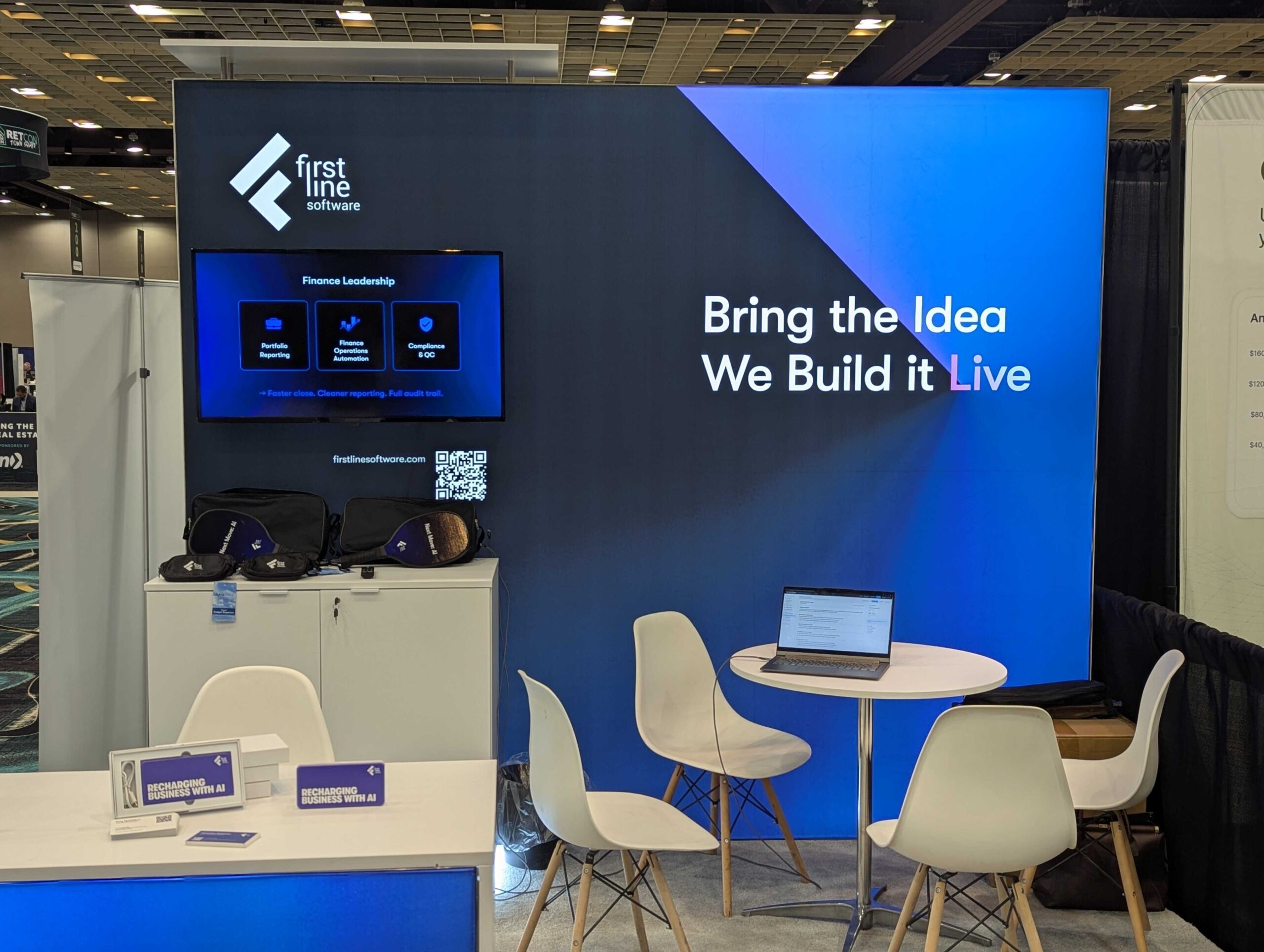
Recently at RETCON, we transformed our booth into a live AI lab. The prototypes we built are a culmination of conversations we had with real estate operators about stubborn pain points, messy workflows, and or bold ideas for AI implementation.
Each prototype was designed to be immediately useful for the specific pain point and operation, serving as the first step toward a fully integrated, production-grade system.
Here is a high-level overview of the prototypes, including the operator’s segment and pain points, and where each solution naturally goes next.
1. Third-Party PM Data Accountability Layer
Context: Multifamily Investment Manager (~$2B AUM) struggled to detect degrading Yardi data quality across third-party property managers.
What we built: A data accountability layer that ingests Yardi data and scores each firm on key data characteristics: completeness, anomalies, and consistency—pinpointing exactly where risk is introduced.
What’s next: Expand into automated portfolio reporting powered by validated data, then evolve into continuous monitoring with SLA-based alerting via the FLS Data Foundation (UDP).
2. Investment Committee Synopsis Generator
Context: The analysts at a Multifamily Investment Manager (~$2B AUM) spent excessive time synthesizing IC memos from dense deal documents.
What we built: A structured, source-linked IC memo generator aligned to firm-specific formats—shifting analysts from writers to editors.
What’s next: Extend into full underwriting acceleration, including financial model population and pipeline intelligence.
3. Competitive Property Sentiment Analysis
Context: Asset managers within a Multifamily Investment Manager (~$2B AUM) lacked structured benchmarking of resident sentiment vs. competitors in the same markets.
What we built: A sentiment analysis tool that aggregates public reviews, scores sentiment dimensions, and visualizes trends impacting occupancy and performance.
What’s next: Scale to portfolio-wide reputation monitoring and integrate with PM accountability for continuous intelligence.
4. Property Management System Anomaly Detection
Context: A Multifamily Investment Manager (~$2B AUM) needed a way to detect Yardi data issues without using external machine learning vendors.
What we built: A rules + statistical anomaly detection layer embedded in nightly pipelines.
What’s next: Expand into automated variance explanations and fully managed data operations with quality SLAs.
5. Conversational Portfolio Intelligence (“Talk to Data”)
Context: Leadership of a Multifamily Investment Manager (~$2B AUM) couldn’t quickly access portfolio insights without BI teams.
What we built: A natural-language interface delivering auditable answers grounded in validated data. Note that this AI solution is never the entry-point, but is an aggregate solution based on a series of smaller foundational wins.
What’s next: Scale into full portfolio intelligence after foundational data validation layers are established.
6. REIT Earnings Research Assistant
Context: Acquisitions teams at a Multifamily Investment Manager (~$2B AUM) manually extracted market research insights from 10-Q filings and earnings transcripts.
What we built: A structured research assistant that ingests REIT public filings and earnings transcripts, extracts key data points, and produces comparable summaries across REITs. Designed for repeated use, teams can track performance over time.
What’s next: Feed structured outputs directly into underwriting models and managed research workflows.
7. Construction Loan Draw Package Automation
Context: Manual validation of draw packages caused costly delays for a Luxury Development Firm (~$2B platform).
What we built: A system that validates documents, cross-checks GL data, flags issues, and assembles submission packages.
What’s next: Expand into design review workflows and pre-development due diligence processing.
8. Design Review and Submittal Tracking
Context: For a Luxury Development Firm (~$2B platform), submittals and RFIs were managed chaotically via email.
What we built: An AI-powered routing and tracking layer aligned to contractual deadlines.
What’s next: Scale across all projects using the same document ecosystem and internal champions.
9. Architectural Plans Synchronization
Context: Version drift across drawing sets caused costly rework for the Luxury Development Firm (~$2B platform).
What we built: A document intelligence layer that tracks revisions and enforces acknowledgment.
What’s next: Expand deeper into technical document control and compliance workflows.
10. Pre-Development Due Diligence Processing
Context: Manual extraction of risks from DD documents slowed site evaluation for a Luxury Development Firm (~$2B platform).
What we built: A system that classifies documents, extracts constraints, and flags risks against underwriting criteria.
What’s next: Extend into full underwriting automation and managed deal pipeline operations.
11. Portfolio Conversational Intelligence (Urban Residential Operator)
Context: Urban Residential Owner-Operator (~4,000 units) lacked cross-system visibility into maintenance, leasing, and sellouts.
What we built: A “Talk to Data” interface tailored to real portfolio structures. Note that this AI solution is never the entry-point, but is an aggregate solution based on a series of smaller foundational wins.
What’s next: Justify and build underlying lease and finance intelligence layers to unlock full capability.
12. LP Reporting and Portfolio Performance Automation
Context: Finance teams at a Diversified Real Estate Investment Platform manually assembled complex LP reports under time pressure.
What we built: A workflow that aggregates, normalizes, and drafts source-linked reporting packages.
What’s next: Scale into multi-fund reporting with automated commentary and SLA-backed operations.
13. AI-Powered Appraisal QC and Compliance Review
Context: Ensuring consistency and USPAP compliance across thousands of reports for a National Appraisal Firm with 69 offices, 675+ staff, 200+ MAI-designated appraisers.
What we built: An automated QC system validating 200+ data points per report.
What’s next: Enable advanced AI layers like narrative generation and comp selection.
14. Comparable Selection Assistance for Appraisal Platform
Context: A National Appraisal Firm experienced high variability in how appraisers select comps.
What we built: A unified search and AI relevance ranking tool across multiple data sources.
What’s next: Deepen integration with underwriting and lease intelligence workflows.
15. Report Narrative Generation for Appraisal Platform
Context: A National Appraisal Firm spent hours writing narrative sections for commercial appraisal reports.
What we built: A system that auto-drafts standardized, data-backed report sections using the structured data already captured in the appraisal platforms.
What’s next: Expand narrative automation using trusted QC and data layers already in place.
Closing Thoughts: From Prototype to Platform
Across investment management, development, operations, and appraisal, the pattern is consistent: start with a high-friction workflow, build a working system around it, and then expand outward using a shared data foundation.
At FLS, we focus on building workflow-level intelligence powered by a unified data foundation (UDP) and domain-specific accelerators. That means:
- We don’t start with generic AI—we start with your actual workflows, documents, and systems
- We prioritize traceability, auditability, and control, not black-box outputs
- We design every prototype as a scalable entry point, not a one-off experiment
A Simple Way to Get Started
We typically begin with a focused engagement:
- Identify 1–2 high-impact workflows (reporting, underwriting, construction, or operations)
- Rapidly prototype a working system using your real data
- Validate value with your internal stakeholders
- Expand into adjacent workflows using the same data foundation
This is exactly how the prototypes in this lab were built—and how they evolve into production systems.
Let’s Build Something Real
If you’re interested in seeing what this looks like inside your organization, we’d be happy to run a similar working session with your team.
Because the fastest way to understand the value of AI in real estate… is to actually build it.