
Schema Markup for AI Visibility, Explained

AI-powered search is changing how content is discovered, interpreted, and surfaced. Traditional SEO signals still matter, but they’re no longer enough. Large language models (LLMs) and AI-driven search engines rely heavily on structured data to understand context, relationships, and intent.
That’s where schema markup comes in.
If your content isn’t structured for machines, it’s less likely to be surfaced in AI-generated answers, summaries, and recommendations.
This guide breaks down:
- Which schema types matter most for AI visibility
- When to use each one
- How to implement them effectively
Why Schema Matters for AI (Not Just SEO)
Search engines used to index pages. AI systems interpret meaning.
Schema markup helps bridge that gap by:
- Explicitly defining entities (people, products, services)
- Structuring content into machine-readable formats
- Clarifying relationships between concepts
For AI systems, schema is not a ranking factor—it’s a comprehension layer.
Without it, your content competes on inference. With it, you provide clarity.
The 4 Schema Types That Matter Most for AI Visibility
Not all schema types are equally useful for AI-driven discovery. These four consistently provide the highest impact.
1. FAQ Schema: Optimizing for Direct Answers
Best for:
- Consideration-stage content
- Voice search and AI assistants
- Featured snippets and AI summaries
Why it matters:
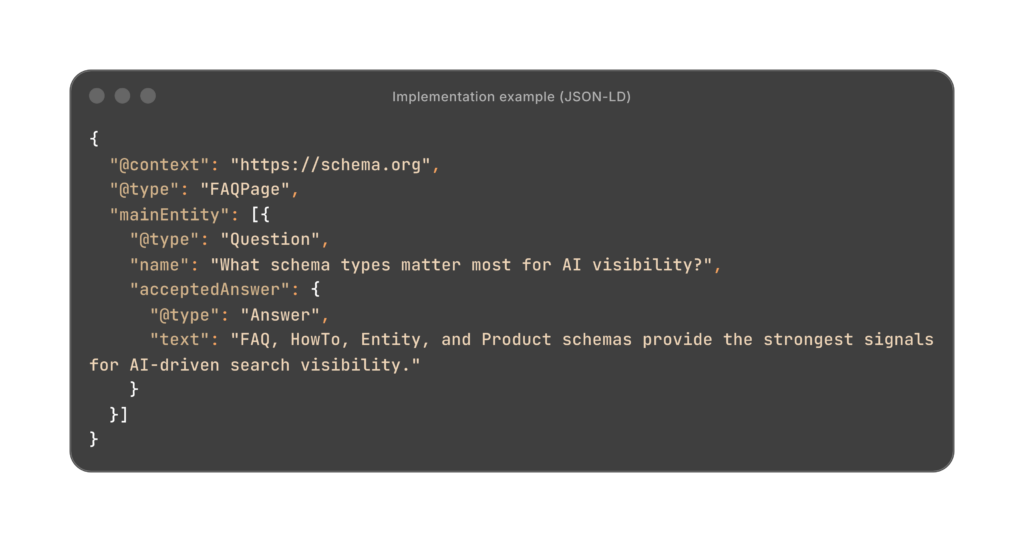
FAQ schema structures your content into clear question–answer pairs, which aligns perfectly with how AI models retrieve and generate responses.
Example use case:
A page answering: “What schema types matter for AI visibility?”
Key tip:
Keep answers concise, factual, and self-contained. AI prefers extractable content.
2. HowTo Schema: Structuring Process-Based Content
Best for:
- Technical guides
- Tutorials
- Implementation walkthroughs
Why it matters:
AI systems prioritize step-by-step clarity. HowTo schema makes procedural content easier to parse and reuse.
Example use case:
“How to implement schema markup for AI visibility”
Implementation structure:
- Define each step clearly
- Use ordered steps
- Include tools or requirements when relevant
Key tip:
Avoid vague steps. Each step should be independently understandable.
3. Entity Schema: Defining Who and What You Are
Best for:
- Brand authority
- Knowledge graph inclusion
- AI trust signals
Why it matters:
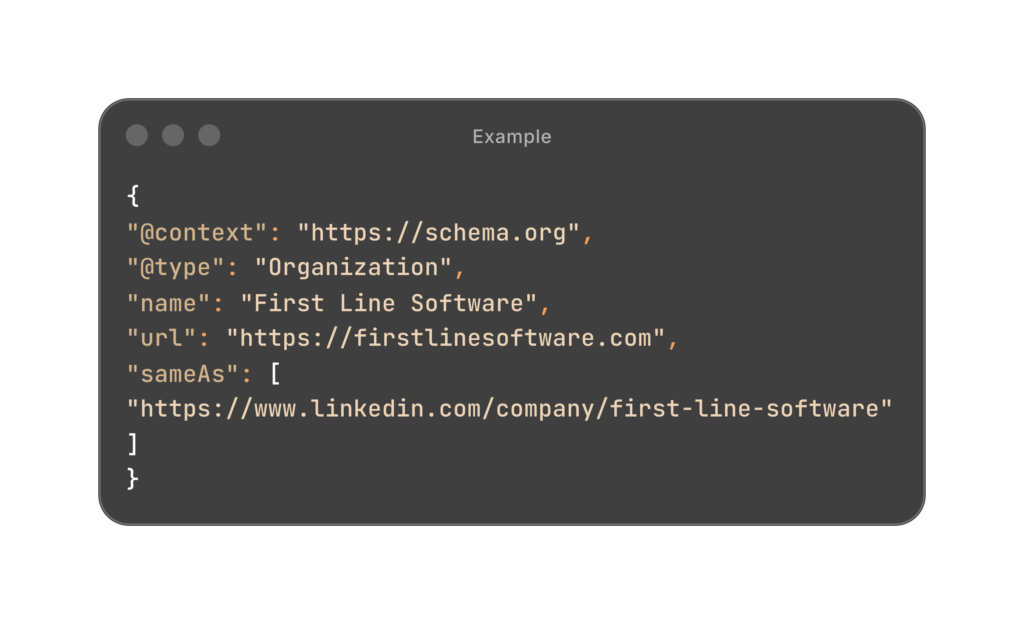
AI models rely heavily on entity recognition. If your company, product, or expertise isn’t clearly defined, it’s harder to associate your content with authority.
Common types:
- Organization
- Person
- Service
- SoftwareApplication
Key tip:
Consistency matters. Use the same naming, URLs, and identifiers across all pages.
4. Product Schema: Supporting Solution Discovery
Best for:
- Service pages
- SaaS offerings
- AI-related solutions
Why it matters:
AI systems increasingly surface solutions—not just content. Product schema helps position your offering as a defined, comparable entity.
Example use case:
Your AI Discovery Audit page
Key elements:
- Name
- Description
- Provider
- Category
Key tip:
Even service-based offerings benefit from Product schema when clearly packaged.
How to Implement Schema for AI Visibility
Step 1: Match Schema to Intent
Not every page needs every schema type.
- Informational → FAQ
- Educational → HowTo
- Brand → Entity
- Commercial → Product
Overlap is fine, but avoid unnecessary complexity.
Step 2: Use JSON-LD Format
JSON-LD is:
- Preferred by search engines
- Easier to maintain
- Cleaner to implement
Avoid inline or microdata unless required.
Step 3: Keep Content and Schema Aligned
Schema must reflect actual page content.
If your FAQ schema includes questions not visible on the page, it can reduce trust signals.
Step 4: Validate and Test
Use:
- Schema validation tools
- Rich results testing
- Manual inspection
Errors reduce effectiveness. Incomplete schema reduces clarity.
Step 5: Think Beyond Search Engines
AI visibility includes:
- Chat-based search
- AI assistants
- Retrieval-augmented generation (RAG) systems
Your schema should support machine understanding, not just rankings.
Common Mistakes to Avoid
- Overloading pages with irrelevant schema
- Using outdated or unsupported types
- Mismatching schema and content
- Ignoring entity consistency across pages
- Treating schema as a one-time setup
Schema is not static—it should evolve with your content and positioning.
How This Connects to AI Discovery
Schema markup is one of the foundational layers of AI discoverability—but it’s only part of the picture.
Without:
- Clear content structure
- Entity consistency
- Intent alignment
Even well-implemented schema won’t deliver results.
This is exactly where an AI Discovery Audit becomes critical.
It evaluates:
- How your content is interpreted by AI systems
- Where structured data is missing or ineffective
- How to align your site with AI-driven discovery models
Final Takeaway
If you want your content to appear in AI-generated answers, summaries, and recommendations, you need more than keywords.
You need structure.
FAQ, HowTo, Entity, and Product schema provide the strongest foundation for:
- AI comprehension
- Content extraction
- Solution discovery
The goal isn’t just visibility—it’s understandability at scale.
Ready to see how visible you are in LLMs? Start your AI Discovery Audit and get your brand seen.
Last updated: April 2026