
From AI Assistants to AI Organizations: A CTO’s Perspective

GenAI CTO
“The future belongs to those who can redesign organizations around AI—not simply add AI to existing organizations.” That is the central message running through Pavel Khodalev’s recent LinkedIn series.
Interestingly, this echoes a broader idea from neuroscientist Robert Sapolsky. He has spent much of his career arguing that humans are products of biology and environment. Change the environment, and entire systems of behavior begin to reorganize.
AI may be doing exactly that to software engineering.
The real disruption isn’t that machines can now write code. It’s that organizations built around humans writing code may no longer be optimized for the world that’s emerging.
For more than two decades, Agile, Scrum, and modern software organizations were designed around a simple assumption: writing software is slow, expensive, and fundamentally human work.
What happens when that assumption no longer holds?
Over the past several months, Pavel Khodalev, CTO at First Line Software, has been developing a remarkably consistent answer to that question. Across a series of LinkedIn posts, he doesn’t simply discuss AI-assisted coding or developer productivity. Instead, he proposes something far more ambitious: a new operating model for AI-native software organizations.
Whether you ultimately agree with his conclusions or not, the series raises important questions for every engineering leader. If AI changes the economics of software development, should we continue organizing teams, projects, and delivery processes as if humans were still the execution bottleneck?
1. Agentic Agile: Why Agile Needs an Upgrade
- Agile is dead. Long live Agentic Agile.
- The Agentic Agile Manifesto
- The triangle moves
- What / How Much / When Were Always Hedges
The Agile Manifesto was written in 2001 for teams composed entirely of humans. AI fundamentally changes that assumption.
According to Pavel, AI agents now deliver production-quality code in seconds. The execution phase is no longer expensive; understanding the problem is.
Traditional Agile optimized around slow implementation:
- sprint planning
- backlog grooming
- standups
- estimation
- coordination
Agentic Agile optimizes around:
- customer validation
- machine-readable requirements
- prototype-first delivery
- AI execution
- human judgment
The result is not “Agile with AI” but a new delivery model where many Scrum ceremonies disappear because they no longer solve the biggest constraint.
2. RACE Programming: A New Delivery Framework
- The Team Structure
- The Board Is a Handoff, Not a Task List
- Engineering Is No Longer the Brake
- RACE Programming Is Open
Main concepts
Pavel introduces RACE Programming (Reliable Agentic Coding Excellence) as First Line Software’s AI-first engineering framework.
Instead of classic Scrum teams, RACE introduces three distinct layers:
Team Principal
Owns product vision and business decisions.
Pit Wall
Pairs a Forward Deployed Engineer with an AI Product role, working alongside the Silicon Software Engineer (the named AI agent embedded in every RACE team), to turn business intent into deployed, working software at the client site.
Responsibilities include:
- prototyping
- customer validation
- executable specifications
- removing ambiguity
Pit Crew
Small engineering teams, each paired with the Silicon Software Engineer, focused exclusively on implementation.
No planning poker.
No sprint ceremonies.
No endless coordination.
The key principle:
Remove uncertainty before implementation starts.
Because ambiguity is resolved upstream, developers spend their time building instead of interpreting requirements.
Read about specific greenfield adoption guides ->
3. Machine-Readable Requirements Become the New Source Code
AI does not need better programmers—it needs better instructions.
Traditional user stories were written for humans.
Future specifications should instead be:
- structured
- executable
- deterministic
- testable
- optimized for AI consumption
This shifts engineering effort away from coding and toward creating precise, machine-readable intent.
4. Small Teams Beat Large Teams
One of Pavel’s more provocative claims is organizational rather than technical.
He argues that AI dramatically reduces the need for large engineering teams.
Instead of scaling people, organizations should scale clarity.
His proposed delivery model relies on:
- three-person implementation teams
- minimal synchronization
- weekly Stints instead of Scrum sprints
- ownership transfer rather than status tracking
The board becomes a visualization of responsibility instead of progress, supporting the RACE cadence built around Stints, the Inner Cycle (Spec → Build → Align), and Pit Stops.
This minimizes communication overhead while maximizing throughput.
5. The Real Bottleneck Has Moved
Historically:
Code generation was expensive.
Today:
Understanding customer intent is expensive.
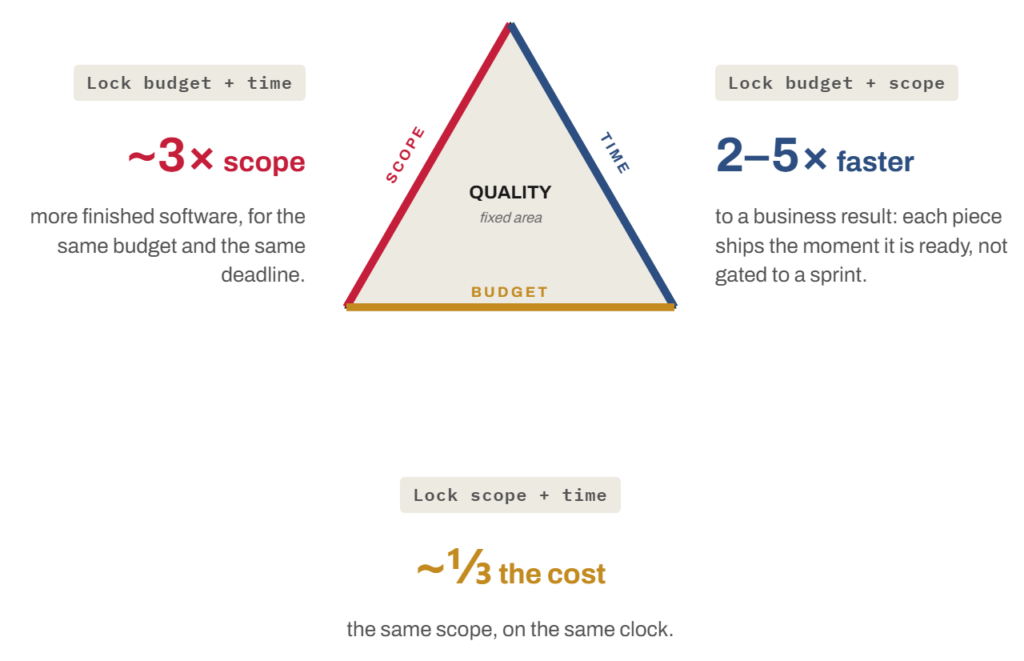
In “The triangle moves,” Pavel frames the trade in concrete terms: holding quality constant, teams take the AI dividend as roughly 3x more scope, about a third less cost, or 2 to 5x faster delivery.
Pavel argues that AI eliminates much of the implementation cost but exposes long-standing weaknesses elsewhere:
- unclear requirements
- changing expectations
- communication loss
- architectural uncertainty
- decision latency
Organizations that continue optimizing developer productivity alone are solving yesterday’s problem.
6. AI-Fluent Engineers: A New Skill Set
Pavel distinguishes AI fluency from prompt engineering.
Future engineers increasingly become:
- architects
- reviewers
- context providers
- orchestrators
- validators
Rather than writing every line of code themselves, they:
- define intent,
- delegate execution,
- validate results,
- iterate rapidly.
In his AI-First Manifesto, he argues that the uniquely human contribution shifts toward judgment, empathy, and validation, while AI increasingly handles information retrieval and code generation.
7. Open Frameworks Over Proprietary Playbooks
Rather than positioning RACE as a proprietary methodology, Pavel published the complete framework publicly—including its assumptions, organizational model, implementation guides, and AI-first principles—and explicitly invited practitioners to challenge it.
His argument is that engineering frameworks should evolve through real-world experimentation rather than remain static consulting artifacts.
8. AI Architecture Beyond Coding
- Practical findings on Enterprise RAG
- Advanced Retrieval-Augmented Generation
Although much of Pavel’s recent content focuses on software delivery, earlier posts complement this perspective by addressing enterprise AI architecture. He emphasizes that successful AI systems depend not only on selecting a capable language model but also on designing robust retrieval pipelines, contextual memory, evaluation mechanisms, and governance. In this view, the surrounding system architecture often matters more than the model itself.
Final thoughts
Across all eight threads, Pavel is making one bet: the constraint in software just moved from execution to judgment, and every part of the organization, from ceremonies to team size to job titles, needs to catch up. Whether RACE Programming holds up outside First Line Software is still an open question, and Pavel is publishing the whole framework precisely so people can test it.
As Alan Kay put it: the best way to predict the future is to invent it.
Follow Pavel Khodalev: linkedin.com/in/khodalev
August 2026