
10 B2B Marketing Workflows to Automate with AI in 2027

In 2027, B2B teams should automate the work AI agents handle better than people. That means watching the market, reading buyer signals, drafting content and outreach, and keeping the brand visible in AI search. Strategy, final decisions and client relationships stay with people.
The ten workflows below are not theory. They run every week in the marketing department at First Line Software. Within our own team, we built a system of AI agents that monitors events, competitors, and accounts. It also turns buyer questions into content, turns won deals into case studies, and gives sales a ranked list of who to contact and why now.
The results are already measurable. As Maria Doronenko, our VP of Digital Marketing & Brand, shared in a recent LinkedIn post, we calculated the impact of just two of our agents: about $120,000 in annual savings. That post covers five ways marketing teams can use AI today, from creative production to AI visibility. This guide goes one level deeper into the specific workflows you can hand off to AI agents and how they connect to form a single AI-native system.
We now bring the same approach to clients through MAIS® for Marketing, our managed AI marketing service. It covers content and campaign operations, lead management, market and competitor intelligence, and marketing analytics. While reading this guide you will see which part of it each workflow belongs to.
This guide is for CMOs, heads of demand generation, and marketing operations leaders at B2B companies. For each workflow, you will see what it does, why it matters in 2027, and how it works in practice.
What is the biggest B2B marketing trend for 2027?
The biggest trend for 2027 is agent-ready marketing. B2B marketing now has two audiences: the buyer and the buyer’s AI assistant. Before buyers talk to a vendor, they ask ChatGPT, Perplexity, or Google AI Mode for a shortlist. Soon, their own AI agents will compare vendors for them.
The numbers point the same way:
- More than 90% of business buyers already use or plan to use generative AI to support purchase decisions (Forrester, via MarketScale).
- For a quarter of B2B buyers, generative AI has already overtaken traditional search for vendor research. In the US, 48% of buyers use it to discover vendors (Responsive, via Demand Gen Report).
- Gartner expects AI agents to intermediate 90% of B2B purchases by 2028, worth more than $15 trillion (Digital Commerce 360).
Most marketing teams are not there yet. In BCG’s 2026 survey, 96% of CMOs said AI is transforming marketing end-to-end. But only 8% run campaigns where several AI agents work autonomously, and only 20% of B2B CMOs see a significant, measurable revenue impact (BCG, via Communicate Online).
That gap is the opportunity for 2027. Agent-ready marketing rests on three ideas:
- Be visible to machines. AI assistants must find your company and describe it correctly.
- Act on signals, not calendars. Plans that refresh once a year are too slow for how buyers now research.
- Free people for expertise. Forrester predicts that human expertise will rival generative AI in appeal, with expert conversations appearing earlier in the buying process (Forrester 2026 predictions). AI takes the research and drafting, so experts have time to talk to buyers.
The 10 B2B marketing workflows to automate with AI in 2027
The workflows below follow the funnel, from being found to closing the loop. Each one runs in our own marketing team today, or is the next one we are building.
1. AI visibility monitoring
How do you know if AI assistants recommend your company? AI visibility monitoring checks how often, and how accurately, AI assistants mention your brand when buyers ask category questions. Examples: “best AI engineering companies for real estate” or “alternatives to [competitor]”.
- Why it matters in 2027: if ChatGPT or Perplexity leaves you off the shortlist, the buyer may never visit your website.
- How it works in our team: every two weeks an AI agent asks a fixed set of buyer questions across Google Search, Google AI Mode, ChatGPT-class models and Perplexity. It records where we appear, where we are missing and where the description is wrong. Every gap goes straight into the content plan.
- What you get: visibility per AI engine, week over week, plus a list of questions you need content for.
Related: AEO and GEO services: how to become the source AI trusts · Free check of your brand in AI search: AI Visibility Audit
2. Buyer-signal intelligence
How do you learn what buyers actually worry about? Buyer-signal intelligence reads what your personas say in public, such as LinkedIn posts, Reddit threads, podcasts, conference talks, and newsletters. It turns that into pains, goals, and buyers’ questions in their own words.
- Why it matters in 2027: content and offers built on real buyer language beat content built on internal assumptions.
- How it works in our team: every Friday, an agent produces a signal card for five personas (CTO, CDO, CMO, CPO, CEO). For each persona, it suggests which of our services fits this week’s top pain, which topic to write about, and which accounts are warm right now. It works at the role level only, with no personal data.
- What you get: a weekly brief that marketing and sales can use the same day.
3. Signal-driven content planning and drafting
How do you decide what content to create next? Signal-driven content planning ranks topics by real demand, then drafts articles built to be quoted by AI engines (AEO/GEO).
- Why it matters in 2027: a content calendar planned once a quarter cannot keep up with what buyers ask this month.
- How it works in our team: every Monday, an agent ranks the top 10 topics. It measures how often buyers ask about a theme, upcoming events, competitor gaps, and questions where AI assistants don’t mention us. On request, it drafts an article with a direct answer, real buyer questions in the FAQ, case-study proof, and our brand voice. A scripted quality check scores every draft before an editor sees it.
- What you get: a first draft in minutes instead of days. Editors spend their time on insight, not structure.
4. Account and trigger monitoring
How do you catch buying signals in your target accounts? Account and trigger monitoring watches clients and prospects for events that open a conversation, such as M&A, a new executive, a funding round, a product launch, or a partnership.
- Why it matters in 2027: the window after a trigger is short, and nobody can watch 100+ accounts by hand.
- How it works in our team: every Monday, account owners get a priority brief and a personal tab with signals and a suggested outreach angle. M&A news triggers an instant alert.
- What you get: fewer missed moments and outreach with a real reason behind it.
5. Competitive intelligence digest
How do you keep up with competitors without a full-time analyst? A competitive intelligence digest tracks competitor news, launches, and leadership changes, and explains what each move means for you.
- Why it matters in 2027: competitors change positioning faster than annual planning cycles.
- How it works in our team: a weekly digest ranks competitor moves and adds implications and actions for FLS. Scripts collect and filter the news first, and AI only summarises and scores what survives. That keeps it cheaper and easier to repeat.
- What you get: a 5-minute weekly read instead of hours of searching.
6. Outreach research and drafting
How do you personalize outreach at scale without spamming? Outreach research and drafting finds target companies, removes existing clients, researches each one, finds public decision-makers, and drafts the first messages.
- Why it matters in 2027: mass email is getting harder to justify. Buyers respond to outreach that shows you understand their situation.
- How it works in our team: a seller describes a campaign in plain English, for example, “UK, retail, 200–2,000 employees”. The agents return a ranked list with evidence and a “why now” for each company, plus the right contacts. They then draft an email, a LinkedIn note, and a follow-up. A person always reviews and sends.
- What you get: research that took 2–4 hours per batch arrives as a ready worklist.
7. Event intelligence
How do you make events pay off beyond the booth? Event intelligence scores upcoming conferences, flags speaker deadlines, and shows which clients and competitors will attend. It then tracks how event leads move through the funnel.
- Why it matters in 2027: events are expensive. They should feed content, buyer questions, and pipeline, not stand alone.
- How it works in our team: a Monday scan scores events from 0 to 10, and anything above 8 triggers an alert. We are now adding a follow-up report on event-sourced contacts.
- What you get: fewer wasted events and a clear line from event to pipeline.
8. Proof engine: from won deal to case study
How do you turn every won deal into proof? A proof engine spots won deals, collects the story from the delivery team, and drafts a case study. It then makes every proof point easy to find for sales.
- Why it matters in 2027: buyers and AI assistants both trust specific, cited evidence, and most teams never have enough of it.
- How it works in our team: when a deal is won, an agent prepares eight short questions for the deal owner, collects the answers, and drafts a nine-section case study. The client is anonymized by default, and every claim is tied to a source. A search agent then lets anyone find case studies, one-pagers, and decks by industry or technology, with NDA clients hidden automatically.
- What you get: more case studies, published faster, and sales that can find the right proof in seconds.
9. Pre-meeting briefs and post-call follow-ups
How do you prepare for every sales meeting in minutes? Pre-meeting briefs pull everything known about a lead before the call. After the call, follow-ups turn the conversation into CRM updates and a follow-up email.
- Why it matters in 2027: the time sellers save goes to the expert conversations buyers now value most.
- How it works in our team: this is the next workflow we are building, on top of the research that the other agents already collect. CRM updates will always need a person to confirm.
- What you get: better-prepared calls and follow-ups that go out the same day.
10. Closed-loop marketing analytics
How do you know which AI-driven activities actually work? Closed-loop analytics pulls results across channels every month, judges them against goals, and feeds the findings back into planning.
- Why it matters in 2027: without this loop, AI makes marketing faster but not smarter.
- How it works in our team: we built a first version that reports across LinkedIn, the website, Search Console, and Google Ads. We are now reworking it so the findings feed directly into topic ranking and outreach priorities.
- What you get: a system that learns which content and outreach drives the pipeline.
How do these workflows work together?
The real value comes from connecting the workflows, not from running ten separate tools. In our team, each agent writes its results to a shared knowledge layer, and the others reuse them.
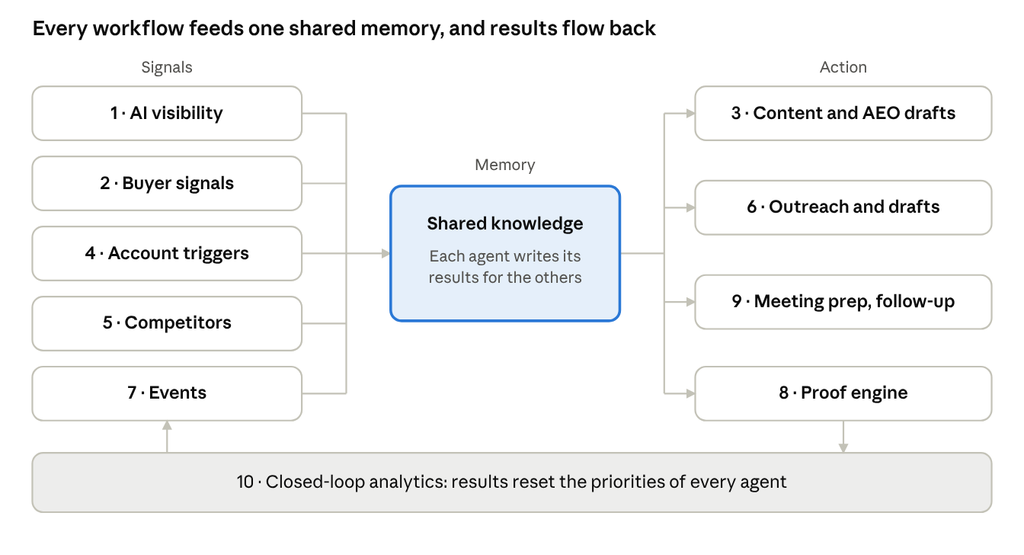
Buyer signals shape both content topics and outreach angles. AI-search gaps become articles, and published articles are measured again for visibility. Won deals become proof that content and sales both cite. Analytics then tells every agent what to prioritize next month.
What should B2B marketers not automate?
Automate research, monitoring, and first drafts. Keep judgment, final approval, and relationships with people. This is the rule our team works by:
| Task | AI agents do | People do |
|---|---|---|
| Market and account research | Collect, filter, rank, and flag the “why now” | Decide which signals are worth acting on |
| Content | Rank topics, write the first draft, check structure | Add insight and opinion, edit, approve, and publish |
| Outreach | Find targets and contacts, draft messages | Review, personalize further, send |
| Case studies | Collect answers, draft, anonymize | Confirm facts with the client, approve |
| CRM | Propose updates | Confirm every write |
| Positioning and strategy | Supply evidence | Own the decision |
Two guardrails matter as much as the automation. First, nothing goes out, gets published, or is written to the CRM without a person approving it. Second, data stays safe: buyer insights are role-level only, and clients under NDA never appear in anything meant for external use. Forrester predicts that ungoverned use of generative AI will cost B2B companies more than $10 billion in 2026. Governance is part of the design, not an afterthought.
How do you start automating marketing workflows with AI?
Start with one workflow that saves time every week, then connect the next one to it. This is how we built our system, one month-long iteration at a time:
- Map your workflows and data. List the recurring tasks your team does by hand and where their data lives. Pick two or three that repeat weekly and have clear inputs, such as event research, competitor tracking, or account monitoring.
- Build small, connect early. Give each workflow one job and one owner, and let it write its results where the next workflow can read them. Persona insights that feed content planning and outreach are worth more than three separate tools.
- Measure and add guardrails from day one. Track hours saved and pipeline influenced, add a health check that shows every agent ran on time, and keep a person on every external action.
In our team, the first two workflows were producing results within the first two weeks. The compounding value comes when the workflows start sharing what they learn.
If you want help, MAIS® for Marketing follows the same path: Discovery, an AI marketing roadmap, implementation, and then ongoing management. Teams that are just starting with AI can begin with the AI Enablement Program, which builds practical AI skills and workflows inside business teams.
FAQ
What is an AI marketing workflow?
An AI marketing workflow is a recurring marketing task, such as competitor tracking or outreach research, that an AI agent runs end-to-end on a schedule or on request. It collects data, interprets it, and delivers a ready output, such as a digest, a list, or a draft. A person reviews the result before anything goes outside the company.
What is agent-ready marketing?
Agent-ready marketing means building marketing for two audiences: buyers and the AI assistants and agents they use to research vendors. In practice, your brand is visible and accurately described in AI answers, your team acts on live buyer signals, and AI handles research so people can focus on expert conversations.
Will AI agents replace B2B marketing teams?
No. In our team, AI agents replace hours of manual research and first drafts, not people. Marketers spend the time saved on positioning, editing, client conversations, and decisions. Every external action, from sending an email to publishing an article, still needs a person to approve it.
Which workflow should a B2B team automate first?
Start with a weekly workflow that has clear inputs and a visible time cost, such as competitor monitoring, event research, or account signals. These show value quickly and create data that later workflows reuse, such as content planning and outreach drafting.
How do you measure the ROI of AI marketing automation?
In our team, two agents alone account for about $120,000 in annual savings. To measure your own, track three things per workflow: hours saved compared with the manual process, outputs produced (drafts, lists, case studies), and pipeline influenced (meetings and opportunities that came from AI-sourced signals). Add a monthly review so the findings change what the agents prioritize next.
Build your own AI marketing team
We built this system for our own marketing department first. Now we run it for clients as MAIS® for Marketing: we map your marketing workflows and data, build the agents that fit your team, and manage them over time, with clear ownership, quality control, cost tracking, and data protection.
Find out which of these 10 workflows fit your team. Request an AI Marketing Assessment
Want to see more examples first? Explore our AI Lab and managed AI services (MAIS®).
Sources
- Forrester 2026 B2B marketing, sales, and product predictions (BusinessWire)
- Forrester 2027 B2B Summit and planning for AI search (MarketScale)
- GenAI overtakes search for a quarter of B2B buyers, Responsive report (Demand Gen Report)
- Most CMOs see AI transforming marketing, but few adopt agentic AI, BCG (Communicate Online)
- Gartner: AI agents to intermediate $15 trillion in B2B purchases by 2028 (Digital Commerce 360)
Last Updated: October 2026