
Top 10 Australian Healthcare System Pain Points in 2026

What health system leaders, digital health companies, and aged care operators in Australia are solving for right now—with sources and engineering implications.
Published: September 2026
Australia’s healthcare system is navigating a period of simultaneous structural reform and digital transformation. The Aged Care Act 2024 is reshaping how care is delivered to older Australians. A federal FHIR mandate is changing how all digital health systems connect to My Health Record. Workforce shortages are reaching critical levels across nursing, general practice, mental health, and aged care. And a chronic disease burden affecting 61% of the population is placing sustained pressure on every layer of the system.
This digest maps the ten most consequential pain points shaping Australian healthcare in September 2026, drawn from AIHW reporting, federal government data, and sector-specific research.
1. Healthcare Workforce Shortage
The short answer: Across almost every health discipline, Australia’s workforce cannot meet current demand — and the gap is widening.
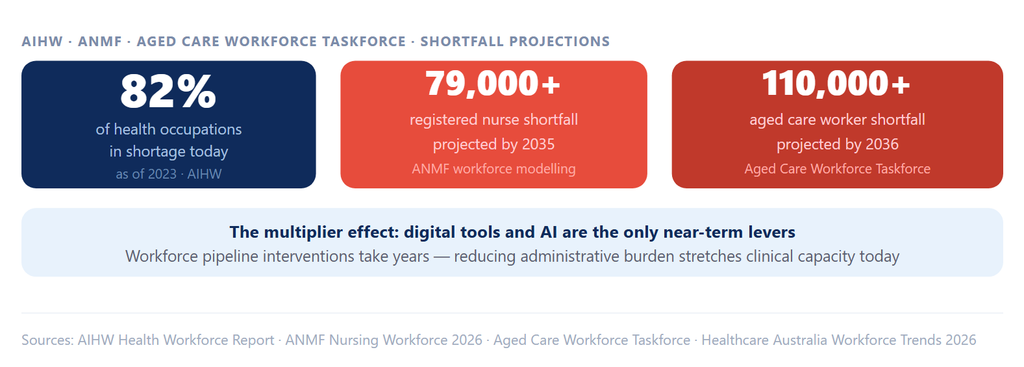
The Australian Institute of Health and Welfare (AIHW) reports that healthcare workforce growth is running consistently slower than demand, driven by an ageing population and rising rates of complex chronic conditions. As of 2023, approximately 82% of health occupations were experiencing shortages particularly in general practice, mental health, nursing, and allied health. The Department of Health’s workforce modelling projects a shortfall of around 79,000 nurses by 2035.
Geographic concentration compounds the problem. Demand for nurses, aged care workers, and allied health professionals significantly outpaces supply in regional and remote Australia, where health outcomes are already worse than in metropolitan areas.
The near-term lever available to health organisations is augmenting existing workforce capacity through clinical AI, automated workflows, and better digital tools — reducing the time clinicians spend on non-clinical tasks so clinical capacity stretches further.
Engineering connection: AI-powered clinical workflow design — ambient documentation, intelligent routing, and structured data capture — directly reduces administrative burden on the clinical workforce.
2. Aged Care System Reform and Compliance Pressure
The short answer: The Aged Care Act 2024 introduced legally enforceable care standards effective November 2025, and operators are still building the systems and processes to comply.
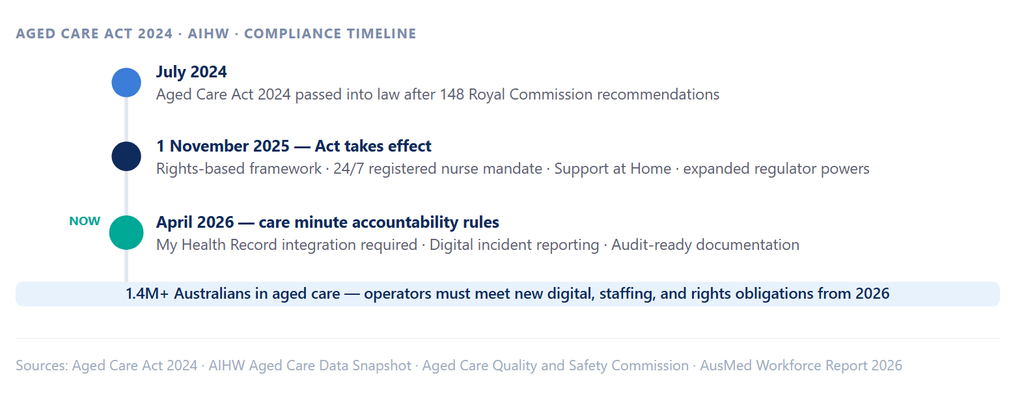
The Royal Commission into Aged Care Quality and Safety made 148 recommendations in its 2021 final report. The resulting Aged Care Act 2024 came into effect on 1 November 2025, establishing legally enforceable rights for older Australians in government-funded care, mandatory staffing standards (24/7 registered nurse requirement, care minutes mandates), the new Support at Home home care structure, and expanded regulator powers — with additional care minute accountability rules taking effect from April 2026.
The direct care workforce shortfall stands at over 38,000 workers nationally, with projections of 110,000 by 2036. Almost two in five aged care workers rated staffing levels at their workplace as “poor” or “very poor” in a 2026 ANMF survey, and 47.52% said nurse-to-care-worker ratios were inadequate.
For aged care operators, this is simultaneously a compliance challenge and a workforce technology challenge. Documentation of care minutes, incident reporting, and audit readiness all require digital infrastructure that many providers have not yet built.
3. Mental Health Access Gap
The short answer: 2.3 million Australians with a mental health problem are receiving no care at all, and the system has no near-term capacity to close the gap.
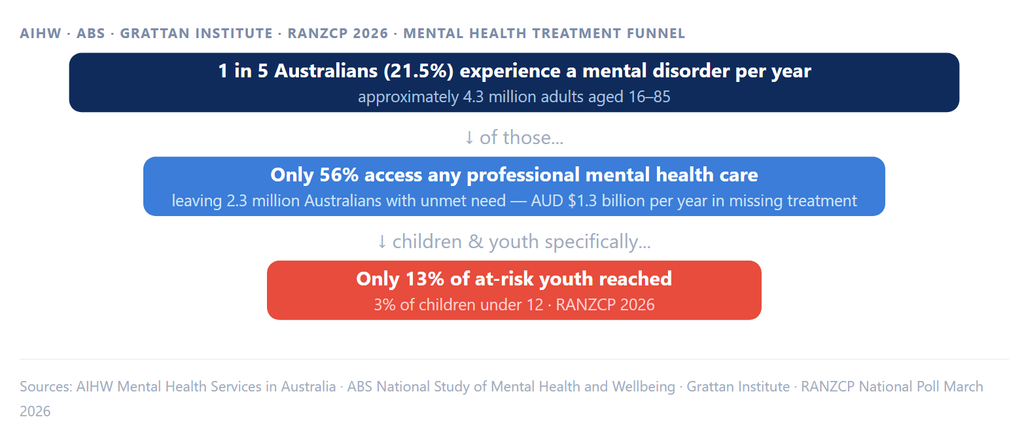
Approximately one in five Australians (21.5% of those aged 16–85) experience a mental disorder in any given year, but only 56% of those access professional support. The Grattan Institute estimates the gap at over 2.3 million people with an unmet need, representing approximately AUD $1.3 billion per year in missing treatment.
The youth crisis is particularly severe. While approximately 1.25 million children and young people experience mild or moderate mental health needs annually, current service models are projected to reach only 13% of this population by 2026. For children under 12, that figure drops to 3%. A March 2026 RANZCP national poll found 77% of Australians are concerned about the growing shortage of psychiatrists, 71% say the mental health system is not meeting people’s needs, and median specialist wait times have risen from two weeks to nearly seven weeks over the past decade.
First Nations adults are 2.5 times more likely to experience high psychological distress, and remote residents 1.6 times more likely to face access barriers. Cost blocks 33% of people from seeking care.
4. GP Access and Primary Care Affordability
The short answer: Bulk billing rates are recovering, but access to timely, continuous GP care remains a significant structural problem — particularly outside major cities.
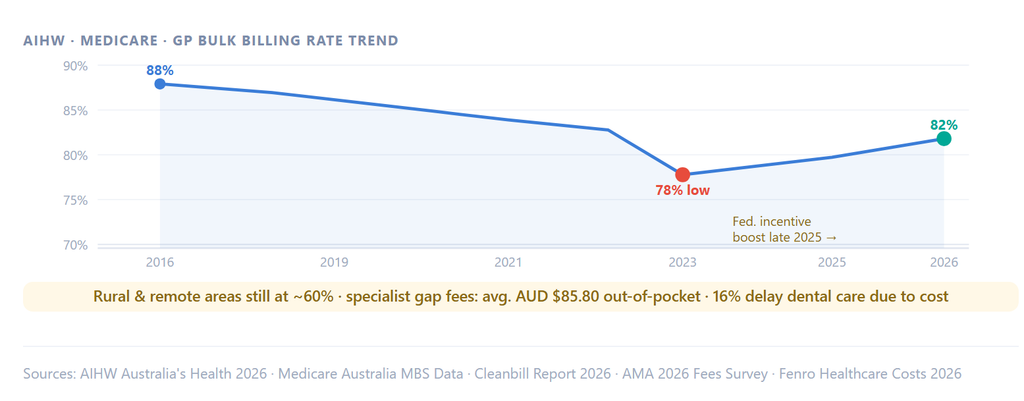
The national bulk billing rate declined from 85% in 2015–16 to 78% in 2024–25, according to AIHW. Following government incentive changes in late 2025, the rate has recovered to approximately 82% in early 2026, and the 2026 Cleanbill Report found just over 40% of GP clinics now fully bulk billing — almost double the start of 2025. The 2025 federal budget committed $7.9 billion to reach 90% bulk billing by 2030 for eligible patients.
However, improved billing incentives do not automatically translate to better access. Higher bulk-billing rates do not by themselves indicate shorter waits, greater acceptance of new patients, more doctors, or better continuity of care. Specialist out-of-pocket costs — gap fees ranging from tens to hundreds of dollars — remain a significant barrier, with 16% of people in 2024–25 delaying dental care due to cost.
5. Chronic Disease Burden
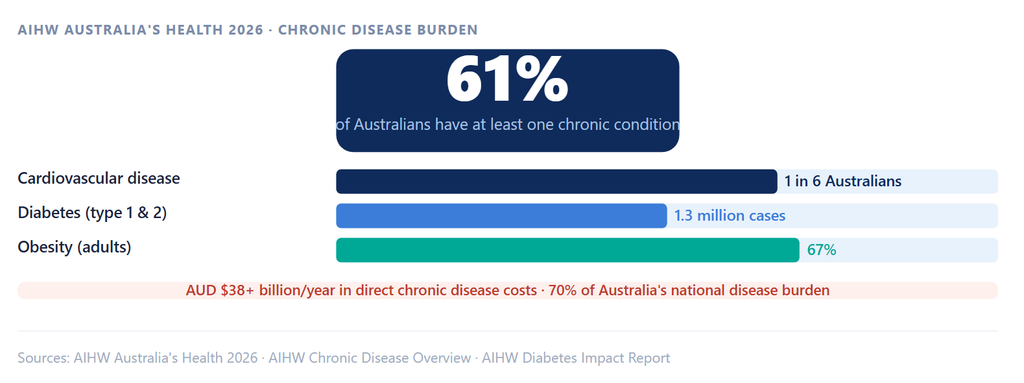
The short answer: 61% of Australians live with at least one chronic condition — and chronic disease now drives 91% of the non-fatal disease burden in the country.
According to the AIHW Australia’s Health 2026 report, approximately 15.4 million Australians (61%) were living with at least one chronic condition as of 2022. The years lived with disability from chronic conditions rose from 1.6 million in 2003 to 2.5 million in 2023, while years of life lost also increased. An estimated 4.1 million Australian adults are living with diabetes, chronic kidney disease, and/or cardiovascular disease — with 1.3 million having diabetes specifically.
Chronic pain alone affects more than 5.4 million Australians and is the country’s leading cause of disability. Managing this burden requires not just clinical capacity but coordinated data — shared care plans, real-time information exchange between GPs, specialists, and hospitals, and AI-assisted risk stratification to identify who needs proactive intervention before they arrive in an emergency department.
6. Digital Health Interoperability: The FHIR Mandate
The short answer: From April 2026, all connections to My Health Record must meet the new national FHIR interoperability baseline — and the system is simultaneously migrating away from legacy CDA architecture.
This is the most significant regulatory moment in Australian digital health in years. The My Health Record Rules 2026 require all system connections to meet HI Service conformance from 1 April 2026. From 1 July 2026, the first Sharing by Default Rules take effect for pathology and diagnostic imaging, meaning records are automatically shared unless a patient opts out.
The Australian Digital Health Agency has established AU Core and the Australian Core Data for Interoperability (AU CDI) as the national FHIR baseline. Yet adoption remains uneven: while 99% of GP and pharmacy organisations use My Health Record, only 45% of specialists and 21% of aged care providers have activated access — leaving major connectivity gaps across the care continuum.
The federal government has committed $598.3 million over two years to My Health Record enhancements. The transition from CDA to FHIR is accelerating — and organisations that treat this as a compliance checkbox rather than a foundational architecture decision will accumulate technical debt that makes future AI and data initiatives significantly harder.
FHIR compliance is not a checkbox exercise. First Line Software has documented what goes wrong when organisations treat it that way — technically valid endpoints sitting on top of data quality problems that surface in production:
- FHIR Compliance Trap: Why Checking the Box Isn’t Enough
- From FHIR Mandate to Clinical Reality: Clinovera’s Production-First Implementation Framework
- Interoperability as a prerequisite for AI in digital health
7. Health Equity: Rural, Remote, and Indigenous Access
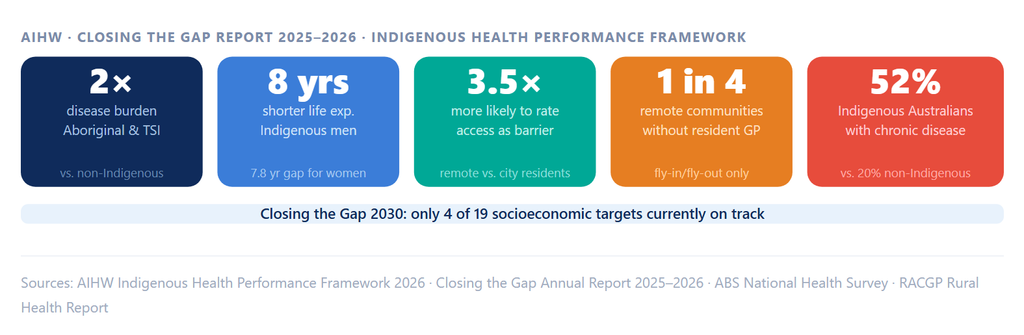
The short answer: 27% of Australians live in rural and remote areas with measurably worse health outcomes — and First Nations Australians carry more than twice the disease burden of non-Indigenous Australians.
AIHW data documents consistently higher rates of hospitalisation, preventable death, and injury in regional, remote, and very remote areas, alongside lower access to primary care. The Indigenous population in very remote areas is 32% of the total population in those areas — disproportionately bearing the access burden. Inequitable access and historical factors account for approximately 47% of the healthcare gap between Indigenous and non-Indigenous Australians.
Telehealth expansion has improved some access metrics since 2020. But digital access to healthcare services requires digital infrastructure — connectivity, devices, and health records that can travel with the patient across providers and geography. Interoperable, FHIR-native systems are not just a metropolitan priority; they are a prerequisite for equitable remote care delivery.
8. AI Adoption: From Pilot to Production
The short answer: Australia’s health sector is investing in AI, but moving from isolated pilots to governed, production-grade clinical AI remains the core challenge.
Brightstar Nursing Australia’s 2026 healthcare outlook identifies AI-driven workforce augmentation and clinical decision support as the defining technology direction for the sector this year. The highest near-term ROI opportunities are administrative: documentation, scheduling, care coordination, and prior authorisation — mirroring the US experience.
The challenge is governance. AI deployed into clinical workflows must be auditable, explainable, and compliant with Australian Privacy Act obligations and the forthcoming AI-specific regulatory framework. Pilots that were not built on clean, structured, FHIR-ready data frequently fail to scale. Production AI in healthcare is less a model problem than a data infrastructure problem.
Engineering connection: First Line’s Unified Data Platform provides the FHIR-native data foundation that makes AI integration reliable and governable — EHR connectivity achievable in 2–4 weeks, with structured outputs that AI systems can consume without bespoke integration work.
9. Cybersecurity and Health Data Risk
The short answer: Healthcare data is among the most targeted in Australia, and aged care and specialist sectors trail on basic digital security maturity.
Australia’s healthcare sector faces persistent cyber threats, with patient records being high-value targets and healthcare organisations frequently underprepared for sophisticated ransomware and supply chain attacks. The Change Healthcare attack in the US — which compromised data for approximately 192.7 million individuals — demonstrated how catastrophically interconnected healthcare data infrastructure can fail.
With the Sharing by Default legislation expanding the volume of data flowing through My Health Record from July 2026, the attack surface for digital health systems in Australia is growing. Aged care providers — many of which are still building basic digital capability — are particularly exposed.
Cybersecurity in digital health is not separable from interoperability architecture: the same data exchange infrastructure that enables FHIR connectivity must be designed with encryption, access control, and audit logging built in from the start, not retrofitted.
10. Healthcare Costs and Private Insurance Pressure
The short answer: Australians are paying more for healthcare across both public and private channels, with the cost burden shifting toward individuals.
Private health insurance premiums increased by 3.73% across the sector in 2026, affecting approximately 15 million Australians. The APAC medical trend sits at 11.3% gross and 8.9% net — reflecting underlying cost inflation that premium increases only partially recover. Out-of-pocket specialist costs remain a persistent access barrier, with gap fees for common procedures ranging from tens to hundreds of dollars.
The government’s investment in bulk billing ($7.9B over the forward estimates), Medicare Urgent Care Clinics (50 new sites nationally), and aged care reform represents a significant effort to rebalance cost burden — but system-level affordability challenges are unlikely to resolve quickly. For health organisations, cost pressure creates both a mandate for operational efficiency and a risk of underinvestment in the digital infrastructure that makes long-term efficiency possible.
How These Pain Points Connect
Australia’s healthcare challenges are structurally linked. The workforce shortage intensifies when clinicians spend time on administrative tasks that AI and better systems could handle. The FHIR mandate creates an opportunity to build the data foundation that enables AI but only if organisations move beyond compliance to genuine architectural readiness. Aged care reform requires digital infrastructure that most providers do not yet have. Mental health access cannot scale to meet demand without telehealth infrastructure underpinned by reliable, interoperable records.
For health organisations and digital health companies, addressing any one of these challenges at scale requires the others to be in view. Technology investment that ignores governance, data quality, or workforce impact tends to deepen the problems it was meant to solve.
FAQ
What is the biggest healthcare challenge in Australia in 2026?
The healthcare workforce shortage — particularly in nursing, general practice, mental health, and aged care — is the most acute operational constraint. Approximately 82% of health occupations reported shortages as of 2023, and the gap is projected to widen significantly over the next decade before workforce pipeline interventions take effect.
What is the My Health Record FHIR mandate and what does it require?
From 1 April 2026, all system connections to Australia’s My Health Record must meet HI Service conformance under the My Health Record Rules 2026. From 1 July 2026, Sharing by Default rules apply for pathology and diagnostic imaging — meaning records are shared automatically unless a patient opts out. The national FHIR baseline is AU Core, established by the Australian Digital Health Agency.
How is AI being used in Australian healthcare in 2026?
The highest-ROI AI applications in Australian healthcare are administrative: clinical documentation, patient scheduling, care coordination, and early risk identification. Production-grade clinical AI requires a FHIR-native data foundation — organisations whose data remains fragmented across legacy EHR systems cannot reliably deploy or govern AI in clinical workflows.
What does the Aged Care Act 2024 require from operators?
The Act (effective 1 November 2025) establishes legally enforceable rights for older Australians in government-funded care, mandatory staffing requirements including 24/7 registered nurses, care minutes accountability (with additional rules from April 2026), restructured home care through Support at Home, and expanded regulator and complaints commissioner powers.
What is Australia’s mental health treatment gap?
Approximately 2.3 million Australians with a mental health condition receive no professional care. The annual cost of unmet need is estimated at AUD $1.3 billion. For children and young people, current service capacity is projected to reach only 13% of those with mild or moderate needs by 2026.
Engineering the Path Forward
Australia’s digital health transformation is accelerating — but the gap between regulatory mandate and clinical reality requires more than software. It requires production-ready systems built on verifiable data, governed AI integration, and interoperability architecture that survives at scale.
At First Line Software’s healthcare practice, Clinovera, we work with digital health companies, regional health systems, and aged care operators on the engineering infrastructure beneath these pain points: FHIR-native data platforms, AI-ready clinical workflows, and My Health Record integration designed for compliance and clinical utility simultaneously. Our Unified Data Platform connects EHRs, devices, and third-party systems using FHIR, OMOP, and i2b2 standards — with EHR connectivity achievable in two to four weeks.
For organisations evaluating their FHIR implementation path — build, buy, or partner — the decision framework is here.
Sources: Australian Institute of Health and Welfare (AIHW) · Australian Digital Health Agency · RANZCP · Grattan Institute · AusMed · Australian Nursing and Midwifery Federation · Productivity Commission · Brightstar Nursing Australia · Tech Business News Australia.