
Agentic SDLC Transformation
Your engineers have Claude Code or Codex. The engineering practice behind them doesn’t exist yet. We embed with your teams for 8–12 weeks, install one agentic coding standard built on RACE Programming, and hand back the numbers that show what changed.
THE PROBLEM
Why Agentic Coding Stalls Without an Agentic SDLC
AI-assisted software development is already everywhere; an AI SDLC is not. Speeding up coding alone lifts that one stage by 30–40%, but team productivity by less than 10% while planning, review and testing stay manual.
Risk is growing.
Token cost, code quality, and who answers for what an agent shipped.
WHAT THE MARKET NEEDS
What engineering leaders need?
Governed – one engineering standard, not ten personal ones.
Measured – delivery outcomes attributed to the spend that produced them.
Accountable – a review discipline built for agentic output and a named owner for every decision an agent makes.
HOW WE SOLVE IT
One Agentic Engineering Standard for Claude Code and OpenAI Codex
MODEL-AGNOSTIC
| — | Claude Code (Anthropic) | Codex (OpenAI) |
|---|---|---|
Repo context | CLAUDE.md standard | AGENTS.md standard |
Reusable team know-how | Skills, subagents, hooks | Skills, AGENTS.md conventions |
Integrations | MCP servers: Git, CI/CD, issue tracker, docs | MCP servers: Git, CI/CD, issue tracker, docs |
Where it runs | Terminal, IDE, CI | CLI, IDE, cloud tasks |
Model policy | Which model per task type, written into the playbook | Which model per task type, written into the playbook |
Why one standard, two agents:
OUR APPROACH
RACE Programming: The AI SDLC Framework Behind the Program
RACE Programming (Reliable Agentic Coding Excellence) is First Line Software’s AI SDLC framework for agentic engineering. Agile coordinates people. RACE manages a team where a new member has joined: the Silicon Software Engineer. It was developed and proven on our own production work before we offered it to anyone.
Prescriptive, not permissive. Every role, artifact and ceremony is specified, not suggested.
Executable User Stories. Our form of spec-driven development: one source of truth that engineers and agents read the same way.
Defined roles. Pit Wall and Pit Crew set who decides, who reviews and who answers for what an agent ships.
Stints. Short delivery units sized for agent execution under human review.
In our own delivery, RACE takes an idea to production in 2–3 days and gives about 3× the output for the same budget. Read the full framework at raceprogramming.com.
Explore RACE ProgrammingWHAT YOU GET
What an Agentic SDLC Transformation Installs
We don’t sell licenses and we don’t teach buttons. We install SDLC automation using agentic AI as one managed engineering practice, measured against your own delivery data.
Goes into your teams:
Executable User Stories, not prompts
An embedded Forward Deployed Engineer
Claude Code or Codex as the agent workforce
Review discipline
Stays with you:
Adoption and cost dashboard
Encoded playbook
ROI report

THE PROGRAM
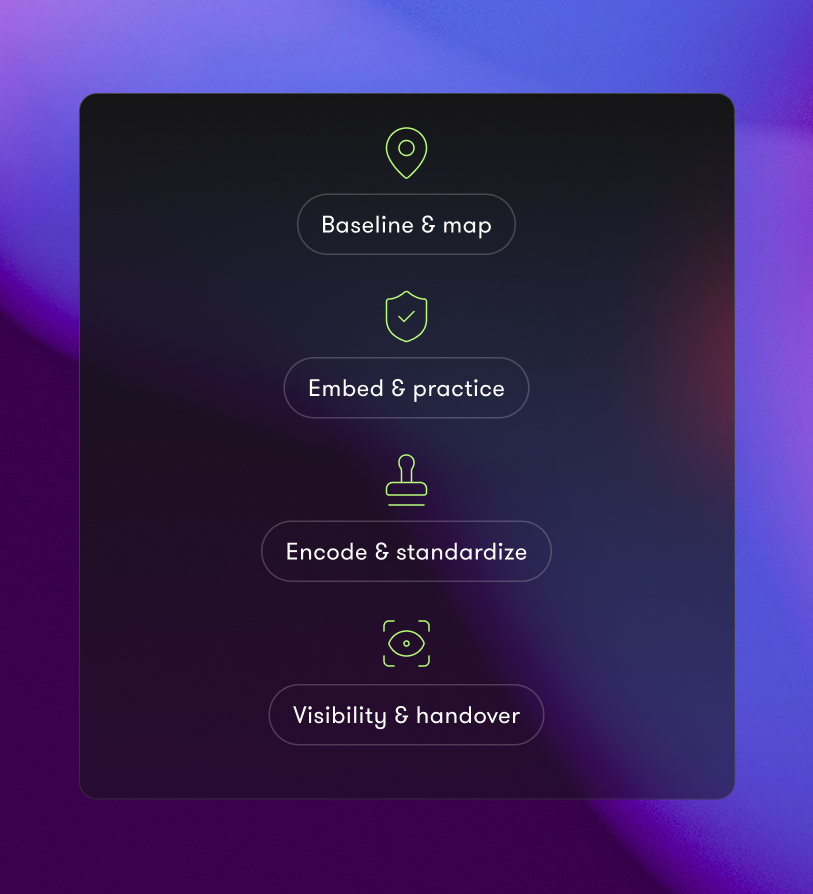
The Program: Four Phases, 8–12 Weeks
Baseline & Map
Week 1-2.
Audit usage, spend and practice; agree target metrics.
Deliverable: adoption baseline.
Embed & practice
Week 3-6.
your FDE pairs on real tickets under RACE Programming.
Deliverable: merged PRs + practice notes.
Encode & standardize
Week 7-8.
What worked for the first teams becomes the org standard.
Deliverable: encoded playbook.
Visibility & handover
Week 9–10.
Before/after numbers your board can read unassisted.
Deliverable: dashboard + ROI report.
Engagement Options
Fixed fee. Three packages, same method; what changes is scope.
Starter
1–2 teams · 8 weeks · 1 embedded FDE, 3 days/week
Prove the model on one high-visibility team.
Standard
4–6 teams · 10 weeks · 2 embedded FDEs
Cross-team model policy + adoption and cost dashboard
Enterprise
org-wide · 12 weeks+ · dedicated team and program manager
Governance policy, full skills library, board reporting cadence.
FIT CHECKWho Agentic SDLC Transformation Is For
Not for
You haven’t licensed a coding agent yet — start with an evaluation
You want a product built from zero — that’s Rapid AI Delivery (Race Mode) →
You want AI workflows for Legal, Finance or Sales — that’s AI Enablement Services
You want a training course with certificates
Best for
You hold Claude Code or OpenAI Codex licenses
and the spend is material
Leadership asks for an ROI answer
and you don’t have one
Practice varies team to team
and you want one standard
You have production code
and real review load
AI Enablement Services Packages:
From One Function to Org-Wide
All packages follow the same method at a fixed fee;
what changes is the number of functions in scope. Claude or OpenAI.
Starter
1 function, 6 weeks
Best for: a motivated champion team that needs a credible win before broader rollout.
1 Enabler · 2 days/week · 1 champion team
✓ Enablement Blueprint
✓ Capability Assessment (before / after)
✓ Validated skill pack
✓ Admin-provisioned plugin bundle
✓ ROI Report
✓ Handover Package
Standard
3 functions, 9 weeks
Best for: organizations with several departments ready to move
1 Enabler · 2 days/week · 1 champion team
✓ All Starter deliverables × 3 functions
✓ Cross-function workflow stacking
✓ Opportunity Brief
Enterprise
5+ functions, 12 weeks+
Best for: org-wide transformation with board-level accountability
Dedicated team + program manager
✓ All Standard deliverables × 5 functions
✓ Company workflow library
✓ Operating Model Blueprint
✓ FLS Claw agents
✓ MAIS Opportunity Brief
Where we apply itClaude Code Adoption works across different industries



Why First Line Software
Our own framework, proven in production
RACE Programming was built and validated on FLS delivery work before we sold it.
Claude Code and Codex, one standard
Select Anthropic Partner depth, without locking you into one vendor.
Measured honestly
Public benchmarks put the median gain near 7–8% and the measured ceiling near 24%. We report where you actually land, including if it’s low.
Fixed-price. Not T&M
Scope, timeline and price agreed before we start.

Agentic SDLC FAQ
What is agentic SDLC?
An agentic SDLC (agentic software development lifecycle) is a way of delivering software where AI coding agents such as Claude Code or Codex do much of the coding, testing and documentation, while engineers write specs, review output and own decisions. It needs defined roles, executable specs, review discipline and metrics, not just agent licenses.
How is this different from training engineers on Claude Code or Codex?
Tool training improves how engineers prompt. An agentic SDLC transformation changes the delivery process itself: spec-driven, role-based, agent-executed, measured. Same licenses, different operating model. An embedded engineer works on your real tickets under RACE Programming, and the result is reported against your own delivery data.
Do you work with OpenAI Codex or only Claude Code?
Both. The engineering standard sits above the agent: the same specs, review checklist, model policy and metrics apply to Claude Code and Codex. First Line Software is a Select Anthropic Partner, but we don’t resell licenses, so we recommend the agent that fits each team and task.
Will agentic coding reduce our AI spend or increase it?
Either is possible, and both are fine as long as you can see which and why. Model policy and context discipline lower cost per outcome; higher throughput can raise total spend. At the end you can state cost per merged PR instead of cost per seat.
How do you measure whether it worked?
Against your own week-one baseline: PR throughput, cycle time, review load and code-turnover ratio, next to spend. Public benchmarks for agentic CLI coding tools put the median near 7–8% and the measured ceiling near 24%. We report where you actually land, including if it is low.
What about code quality, and what do we own at the end?
Agentic output needs a stricter review standard than human code, so the quality number is reported next to the velocity number. Every CLAUDE.md, AGENTS.md, skill and playbook lives in your version control, and the dashboard runs on your data. No dependency on FLS.
The agent licenses are already paid for. An agentic SDLC is what makes them pay back.
Book a Discovery Call
- Thirty minutes with the engineers who would run it — not a sales call. Bring your admin console numbers from Claude Code or Codex, and we’ll tell you whether this is worth doing.