
Unlocking AI Potential with Managed Services

AI becomes more valuable when it moves beyond experiments and into dependable business systems. Managed AI services help organizations plan, build, deploy, and continuously improve artificial intelligence solutions in the cloud, while keeping performance, risk, cost, and business outcomes in view. For teams that want faster adoption without turning every project into a custom infrastructure challenge, this model can make AI practical, scalable, and easier to govern.
What are managed AI services?
Managed AI services are end-to-end services that support the full lifecycle of AI adoption, from strategy and use-case selection to engineering, cloud deployment, monitoring, and ongoing optimization. Instead of treating AI as a one-time software build, a managed approach treats it as a living system that needs tuning, governance, cost management, and operational support.
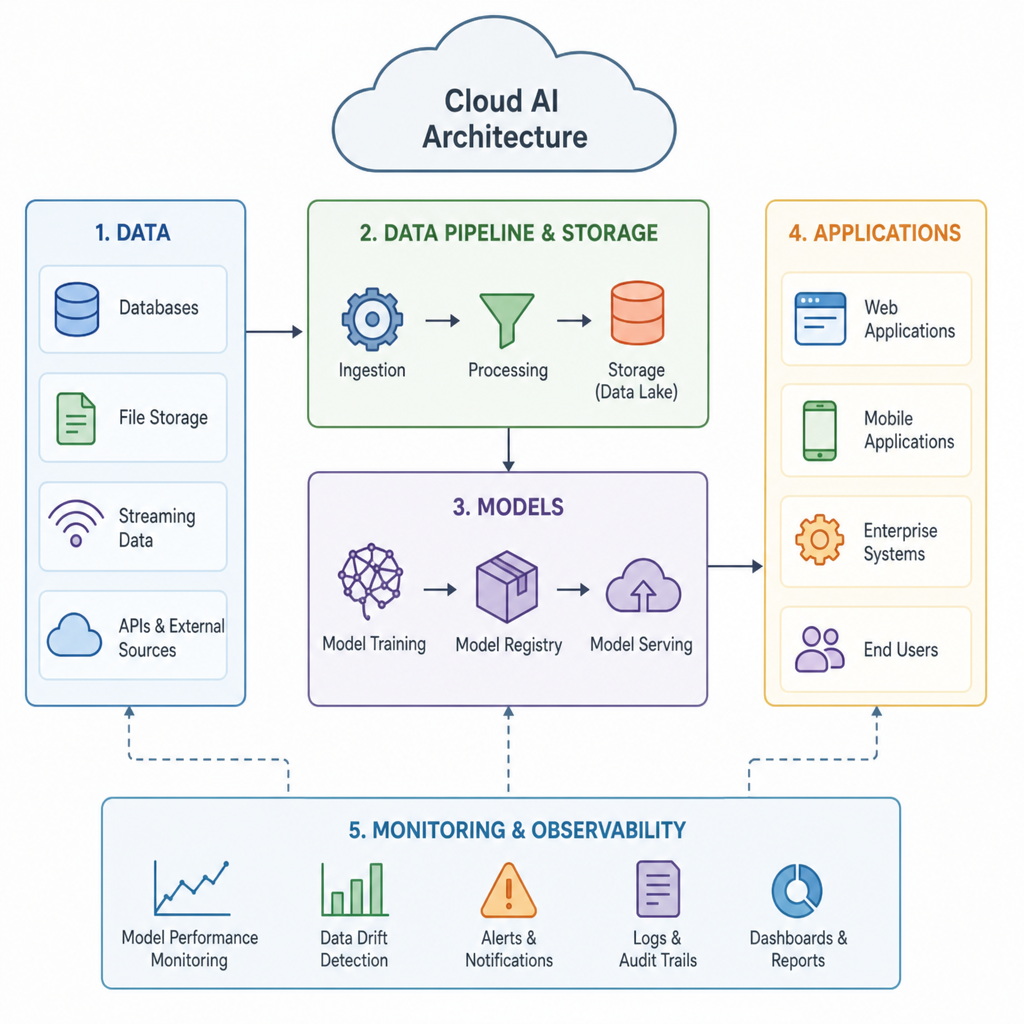
This matters because production AI is rarely just a model. It usually includes data pipelines, prompts, retrieval systems, integrations, security controls, user interfaces, business rules, monitoring dashboards, and human review processes. A managed services partner helps bring these pieces together so AI cloud computing can support real workflows, not just demos.
The best managed approach is also business-led. That means the work starts with questions such as: Which process should AI improve? What outcome matters most? Where could automation reduce friction without adding risk? When artificial intelligence services are aligned with measurable goals, they are more likely to become trusted systems rather than isolated experiments.
Cloud infrastructure turns AI ambition into operating capacity
AI needs flexible computing power, reliable storage, secure access to enterprise data, and the ability to scale when usage grows. This is where ai cloud services become especially useful. Cloud platforms can provide the foundation for model hosting, API orchestration, vector search, data processing, identity management, observability, and deployment automation.
For many organizations, the challenge is not simply choosing AWS, Azure, Google Cloud, or a private cloud environment. The real challenge is designing an artificial intelligence platform that fits business needs, compliance expectations, latency requirements, integration complexity, and budget constraints. A managed team can help compare those tradeoffs without locking every decision to one vendor too early.
A strong cloud AI setup typically supports:
- Secure access to business data, with appropriate permissions and auditability.
- Integration with existing software such as CRMs, ERPs, document repositories, portals, and workflow tools.
- Scalable model and API usage so costs and performance remain visible.
- Monitoring for quality, reliability, user adoption, and exceptions.
- Deployment patterns that allow teams to improve the system without disrupting the business.
In practice, this shifts AI from a tool someone tries on the side to an operational capability the business can manage.
The managed AI lifecycle keeps projects grounded
A full managed AI services lifecycle usually follows a phased path. The order can vary, but the discipline is important: understand the organization first, align use cases with business value, engineer carefully, then manage continuously.
1. Assess AI maturity and readiness
The process often begins with an AI maturity assessment. Some organizations are still at the stage where individual employees use public AI tools informally. Others have pilots, internal automation scripts, or early data science projects. More mature teams may already have model governance, cloud environments, and AI development standards.
A readiness review helps identify what is realistic now and what must be fixed first. That might include data quality, security gaps, unclear ownership, fragmented systems, or a lack of internal AI policies.
2. Align use cases with business outcomes
Not every AI idea deserves investment. Managed teams help prioritize use cases based on revenue impact, efficiency gains, customer experience, risk reduction, or compliance support. This keeps artificial intelligence solutions focused on problems the organization actually needs to solve.
Good candidates often share a few traits: repetitive work, high information volume, expensive delays, complex knowledge retrieval, or decision support needs. Weak candidates tend to have vague goals, poor data access, or unacceptable risk if the AI output is wrong.
3. Engineer cloud-native AI applications
Once a use case is selected, engineering begins. This may include prompt design, retrieval-augmented generation, AI agents, reusable accelerators, workflow logic, model selection, testing, and application development. The goal is not simply to connect an API. The goal is to create a reliable system around the AI.
An experienced artificial intelligence company may combine multiple models, cloud services, data sources, and business rules into one coherent application. For example, one model may classify documents, another may summarize them, and a rules layer may route exceptions to a human reviewer.
4. Deploy, monitor, and improve continuously
After launch, managed AI work continues. Teams monitor usage, quality, latency, cost, hallucination risk, user feedback, incidents, and changes in business requirements. Prompts may need refinement. Models may need replacement. Data sources may change. Compliance expectations may evolve.
This continuous management is one of the biggest differences between a pilot and a production AI capability.
How do managed services reduce AI risk?
Managed services reduce AI risk by building controls into the system from the start and by watching performance after deployment. The main risks are not abstract: AI can produce inaccurate answers, expose sensitive data, fail under production demand, create unexpected cloud costs, or integrate poorly with business processes.
Key risk controls include:
- Hallucination management: Use approved data sources, retrieval systems, confidence checks, validation rules, and human review where accuracy matters.
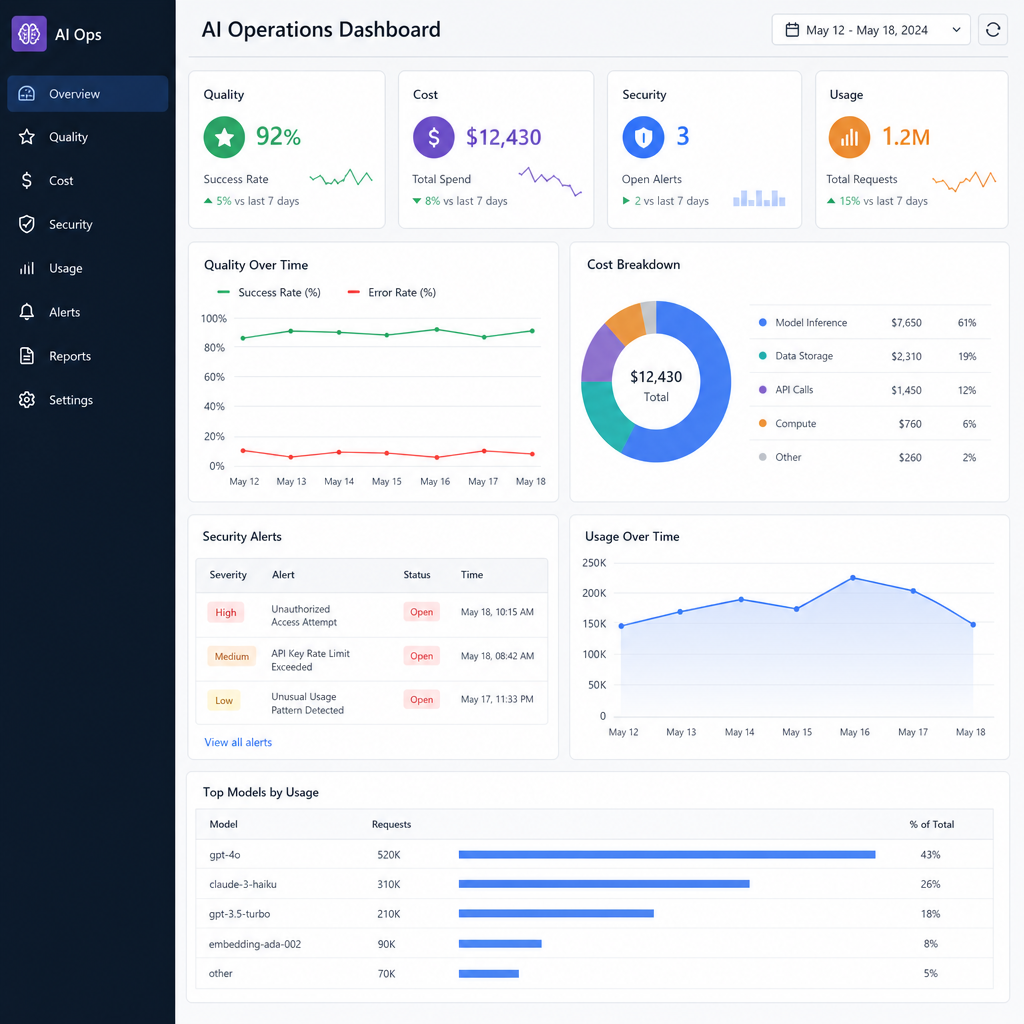
- Cost control: Track model calls, token usage, storage, compute demand, and workflow volume so LLM costs do not grow unnoticed.
- Security protection: Apply access controls, logging, prompt-injection defenses, data filtering, and least-privilege design.
- Compliance support: Build auditability, explainable workflows, retention rules, and governance checkpoints into the AI operating model.
- Operational reliability: Monitor latency, uptime, failed responses, edge cases, and incident patterns so the system can be improved before trust erodes.
These controls are especially important when ai services touch regulated information, customer communications, employee records, financial data, or contractual documents. A managed approach does not remove every risk, but it makes risks visible, assignable, and manageable.
Selecting the right AI cloud approach
Choosing an AI cloud strategy should start with the business problem, not the newest model release. Some use cases need low latency. Others need strong data residency controls, deep enterprise integration, or predictable cost. A customer-facing assistant may require different architecture than an internal document summarization tool.
Useful selection criteria include:
- Business priority: Does the use case support revenue, efficiency, customer loyalty, compliance, or risk reduction?
- Data sensitivity: What information will the AI access, and who should be allowed to see outputs?
- Performance needs: Does the system need real-time responses, batch processing, or human review before action?
- Integration depth: Will the AI need to write back to business systems or only retrieve and summarize information?
- Cost profile: Are usage patterns predictable, seasonal, experimental, or likely to grow quickly?
- Vendor flexibility: Can the architecture support multiple models or clouds if needs change?
This is where an artificial intelligence platform should be designed as an adaptable operating layer rather than a rigid one-off build. Vendor tools matter, but architecture, governance, and integration discipline often determine whether the system lasts.
AI maturity determines the best starting point
Organizations do not need to be advanced to begin, but they do need the right starting point. A managed services model can meet teams where they are and help them move toward more disciplined AI operations.
For early-stage organizations, the first step is often discovery: map current AI usage, set policies, identify safe use cases, and choose one workflow with clear value. The goal is to avoid scattered experimentation and establish a responsible foundation.
For intermediate organizations, the priority is usually production readiness. That may mean connecting AI to trusted data, building user-facing applications, defining success metrics, and creating monitoring processes.
For advanced organizations, managed AI often focuses on scale. These teams may need reusable AI agent patterns, multi-model orchestration, governance automation, cloud cost optimization, and a stronger AI software development lifecycle.
A practical maturity checklist includes:
- Clear business owner for each AI initiative.
- Defined success metric before engineering begins.
- Approved data sources and access rules.
- Testing process for accuracy, safety, and edge cases.
- Monitoring plan for performance, cost, and user feedback.
- Incident response path when AI behaves unexpectedly.
Real-world use cases show the practical value
Managed AI becomes easiest to understand through everyday business scenarios. In commercial real estate, an AI assistant could help process regulatory documents by extracting key details, summarizing obligations, and routing uncertain items for review. In healthcare administration, medical intake automation could reduce manual data entry and help admissions teams handle forms more consistently.
In retail print, AI summarization could accelerate RFP response by pulling relevant details from long request documents and past materials. In online food ordering, a recommendation engine could suggest relevant add-ons or combinations based on context, improving the ordering experience without requiring a massive custom system.
These examples share a pattern: AI is not replacing the business process entirely. It is reducing friction inside a process that already exists. That is often where managed artificial intelligence services create the clearest path to value.
The future belongs to managed, business-owned AI
AI-first enterprises will not rely on disconnected tools forever. They will need governed systems that connect models, data, applications, people, and business objectives. Managed AI services help make that shift by combining cloud engineering, operational oversight, responsible governance, and continuous improvement.
The takeaway is simple: AI potential is unlocked when experimentation becomes execution. With the right managed approach, organizations can build artificial intelligence solutions that are scalable, secure, measurable, and useful in the real world—not just impressive in a proof of concept.
Updated: September 2026